Iron Islands
A Clash of KingsThe Iron Islands are a stern archipelago defined by hostile seas, poor soil, mineral wealth, and a cultural memory of conquest by the axe. They are not merely the Greyjoy homeland: they are the material and symbolic foundation of the ironborn worldview, where the sea supplies danger and opportunity, the land offers little comfort, and the old ideal of taking rather than sowing remains a potent answer to subordination within the wider realm.
Geography and Physical Character
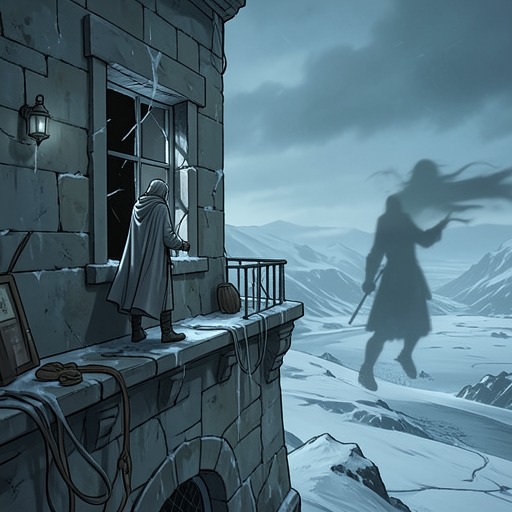
The islands are presented through Theon Greyjoy’s return by sea, a journey that turns geography into memory. With no safe anchorage at Pyke, Theon approaches his father’s castle aboard the Myraham, wanting to watch the stronghold grow before him just as he had once watched it diminish from the rail of Robert Baratheon’s war galley, when he was taken away to become a ward of Eddard Stark. The return is therefore both a homecoming and a test of whether the place he remembers can still claim him. The coast appears as sharp rocks and glowering cliffs, while Pyke seems fused with the same grey-black stone, salt water, lichen, and seabird droppings. The island fortress occupies land that once thrust like a sword into the ocean, until waves battered it apart over thousands of years. What remains is a broken maritime landscape of three barren islands and towering stacks of rock rising from the water like pillars of a sea god’s temple, with angry waves foaming among them. The setting makes endurance look less like triumph than survival amid continual erosion.
Scarcity and the Ironborn Way of Life
Theon describes the Iron Islands as bleak places of scant comfort and mean, meager life. Death is always near. Fisherfolk struggle against the sea, farmers scratch crops from thin soil, and miners break their backs underground for iron, lead, and tin. These resources are the islands’ treasures, but the account also emphasizes the labor and deprivation behind them. The contrast between the islands’ poor productive capacity and their abundant hazards helps explain why raiding became central to ironborn history. The Old Way imagined the ironborn as a people whose proper work was war. In the remembered order, ironmen did not mine or farm; captives brought back from hostings performed those tasks, while ironborn sought wealth, women, glory, and kingdoms through raids. The Drowned God’s supposed design for them was expressed through reaving and violence, and the tradition is condensed in the Greyjoy words, We Do Not Sow. The phrase rejects dependence on agriculture and turns nonproduction into a badge of identity, even though the islands’ survival still rests on the labor that the ideal tries to despise.
History, Conquest, and Political Ambition
The Iron Islands’ older culture was broken by Aegon the Dragon. After burning Black Harren, Aegon returned Harren’s kingdom to the rivermen and reduced the islands to an insignificant backwater within a much greater realm. The conquest transformed the ironborn from an independent raiding power into a peripheral people subject to the political order of the Iron Throne, but it did not erase their historical imagination. Red tales of the old kingdoms continued to circulate around driftwood fires and smoky hearths, even within the stone halls of Pyke. Lord Balon Greyjoy’s title of Lord Reaper and the family’s words preserve that unresolved tension between submission and restoration. Balon’s great rebellion was undertaken less for the empty vanity of a crown than to restore the Old Way. Robert Baratheon ended the rebellion with the help of Eddard Stark, leaving the islands defeated while Theon was raised at Winterfell as a hostage for his father’s good behavior. By the time the great lords and kings were dead and boys ruled in their places, Theon interpreted the realm’s fragmentation as the moment when the old island ambition might return. The Iron Islands thus function as a political memory: a conquered territory whose suppressed past remains available for renewed mobilization.
Fleet, War, and Strategic Position
The islands are also a naval power base. Their port is crowded with sailors loading provisions, soldiers drinking or gambling in packed inns, fishing vessels, carracks, cogs, and war galleys. The naval world around Dragonstone includes Stannis Baratheon’s flagship Fury, Lord Velaryon’s Pride of Driftmark and its sister ships, Lord Celtigar’s Red Claw, the Swordfish, and Salladhor Saan’s great Valyrian among Lysene galleys. This maritime concentration shows how island power operates through ships, berths, supplies, crews, and access to the sea rather than through castles alone. The Iron Islands’ geography also gives them a strategic route into the North. Balon’s plan assigns Victarion the main thrust: after attacks elsewhere draw Winterfell’s response, his fleet is to sail up Saltspear and the Fever River toward Moat Cailin. The Neck is described as the key to the kingdom. If the ironborn hold Moat Cailin, Robb Stark cannot easily return north, and the southern end of the causeway can seal him in like a rat in a bottle. The plan treats the islands not as an isolated fringe but as a maritime hinge capable of severing the northern war effort. The same naval logic appears by contrast in Stannis Baratheon’s assault on King’s Landing. His fleet is organized into ten lines of twenty ships, with successive lines assigned to engage the opposing fleet, land archers and spearmen beneath the city walls, and ferry the main host across the river. Storms, wrecks, and scattered ships delay the force, while the Blackwater Rush and the city’s walls limit the usefulness of mounted troops. The evidence places the Iron Islands within a wider contest in which control of waters, ships, weather, and landing points can matter more than conventional land power.
Encounters with the Wider Realm
The Iron Islands’ isolation is never absolute. Theon’s memories of Winterfell reveal that he has lived within the mainland political order without ever fully belonging to it. Although Eddard Stark raised him among his children, Theon understood that the castle knew he was a hostage, and he contrasts his own status with the greater honor accorded even to Jon Snow. His return to the islands therefore exposes a divided identity: he is shaped by the North but claims inheritance from Pyke. That claim is immediately complicated by the existence of his sister Asha Greyjoy. Theon insists that a woman may inherit only when there is no male heir in the direct line, but his uncle reminds him that his sister lives and that his father is unlikely to hand the holy islands over to a Stark. The dispute reveals how succession, gender, hostagehood, and cultural belonging intersect in the Iron Islands. Theon believes ten years at Winterfell have not made him a Stark, yet the very need to assert that fact shows how deeply the mainland has marked him. The islands’ wider place in the realm is summarized by the Greyjoy account: Balon previously led a rebellion against the Iron Throne, Robert Baratheon and Eddard Stark suppressed it, and Theon later became one of Robb Stark’s supporters and closest companions. Balon nevertheless refused to join the northmen when they marched south into the riverlands. The Iron Islands remain politically separate in imagination even when their rulers operate within the same wars as the mainland kingdoms.